Penny · 1943
1943 Wheat Penny Value
A 1943 penny is worth $0.21 to $4.62 in circulated condition, depending on its mint mark and wear. The record price at auction is $840,000 (Heritage Auctions, 2021).
Prices updated:
Why 1943 pennies are special
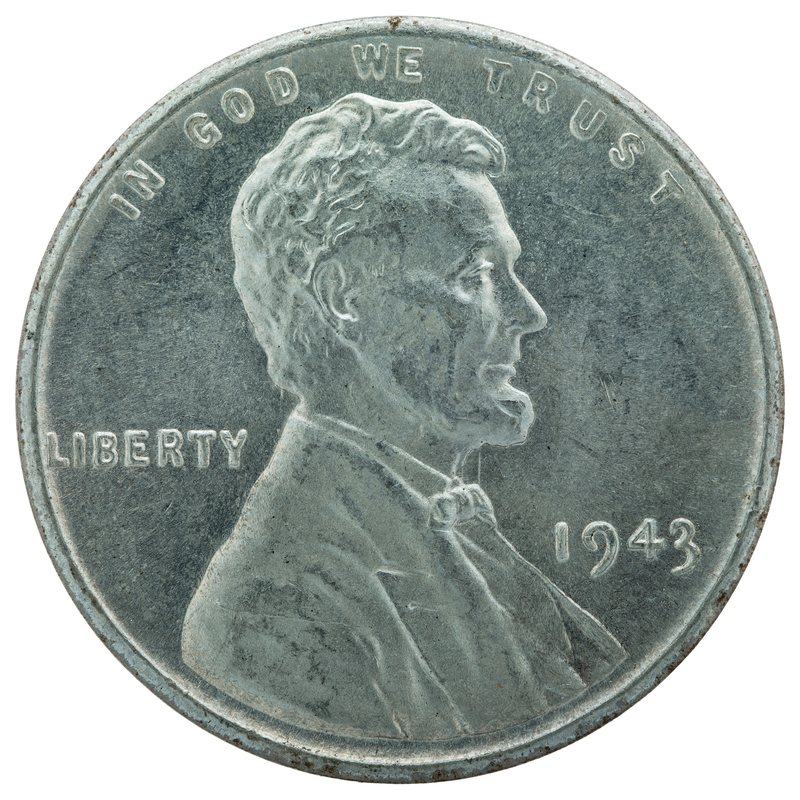
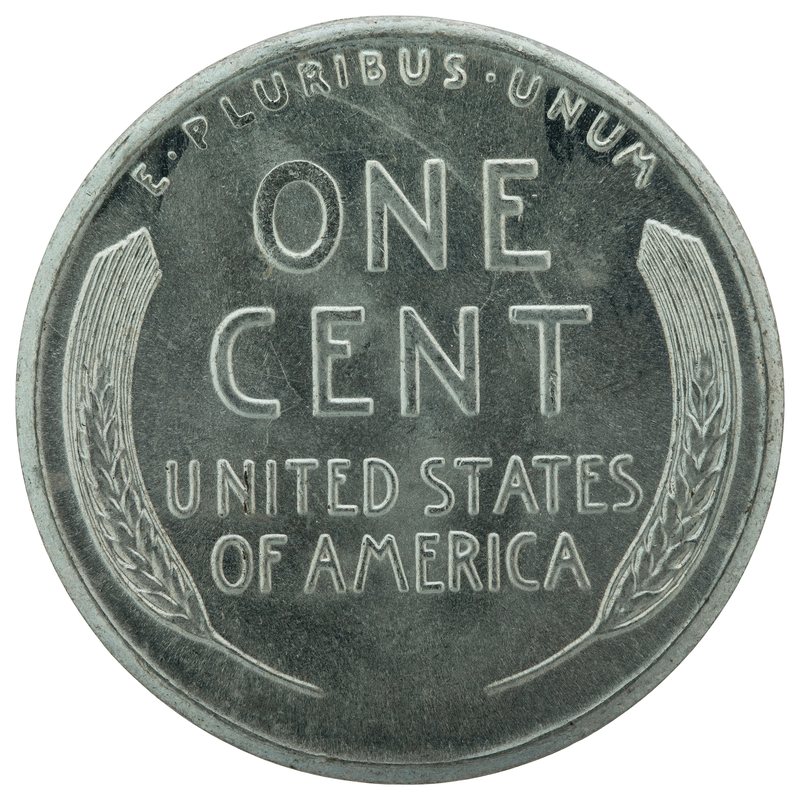
In 1943 the United States was at war, and copper was needed for shell casings and telephone wire. The Mint pulled copper out of the one-cent coin and struck it instead on a blank of steel coated with zinc — the only regular-issue U.S. coin that contains no copper at all. Even the silver and gold coinage of the era was alloyed with copper for hardness; this one was not. That is why a 1943 cent is silver-grey instead of brown, and why almost everyone who finds one assumes they have found something rare.
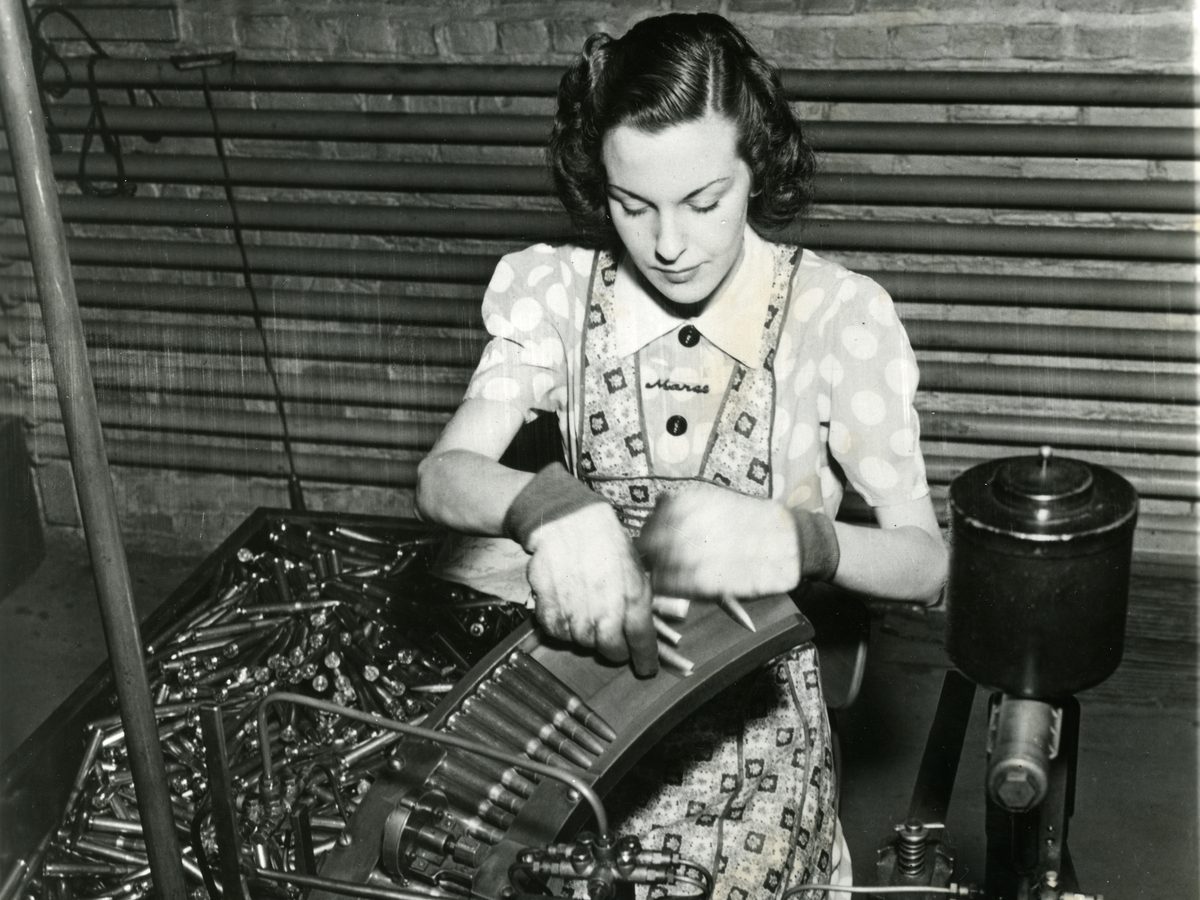
They almost never have. Philadelphia alone struck 684,628,670 of them, Denver added 217,660,000 and San Francisco 191,550,000. Well over a billion were made in a single year, and enough of them were set aside as curiosities that worn examples are still worth only a few cents today. If your 1943 cent is grey and sticks to a magnet, it is one of these — an interesting piece of wartime history, but not a payday.
The rare coin from 1943 is the one that should not exist. When the presses changed over, a small number of bronze blanks left over from 1942 stayed in the machinery and were struck with 1943 dies. Around 20 are known from Philadelphia and around 20 from San Francisco. From Denver there is exactly one. That single Denver coin is the reason this date is famous: it sold for $840,000 at Heritage Auctions in January 2021, after changing hands for $212,750 at Goldberg Auctioneers back in 2003.
So a 1943 cent is really two different coins wearing the same date. One was made by the hundreds of millions and is worth pocket change. The other was made by accident, is brown instead of grey, and is valued individually because no price guide can cover a coin that exists in single figures. Telling them apart takes about five seconds and a magnet — the steel cent sticks, the bronze one does not.
Value chart by grade
| Mint mark | Mintage | G | VG | F | VF | XF | AU | UNC |
|---|---|---|---|---|---|---|---|---|
| No mint mark | 684,628,670684.6M | $0.22 | $0.39 | $0.43 | $0.67 | $1.03 | $1.30 | $2.77 |
| D | 217,660,000217.7M | $0.21 | $0.32 | $0.40 | $0.65 | $0.77 | $1.48 | $3.62 |
| S | 191,550,000191.6M | $0.22 | $0.57 | $0.58 | $0.72 | $1.05 | $1.47 | $4.62 |
What the grades mean
Grades run G to UNC, then MS60–MS70, where most value sits. How coin grading works →
Uncirculated values (MS grades)
Most value lives above UNC — population shows the rarity.
No mint mark PCGS #2711
| Grade | Value | Graded in this grade | Finer |
|---|---|---|---|
| MS60 | $11 | 1 | 17,778 |
| MS63 | $22 | 670 | 16,908 |
| MS64 | $26 | 2,173 | 14,735 |
| MS65 | $30 | 4,344 | 10,390 |
| MS66 | $45 | 7,928 | 2,460 |
| MS67 | $200 | 2,148 | 249 |
| MS68 | $4,250 | 91 | 3 |
Common in circulation, rare in top grade: PCGS has graded only 91 examples in MS68 — that's why the price jumps from $200 to $4,250.
Mint mark D PCGS #2714
| Grade | Value | Graded in this grade | Finer |
|---|---|---|---|
| MS60 | $11 | 1 | 15,370 |
| MS63 | $22 | 494 | 14,767 |
| MS64 | $26 | 1,898 | 12,869 |
| MS65 | $30 | 3,076 | 9,793 |
| MS66 | $42 | 6,507 | 3,286 |
| MS67 | $185 | 2,838 | 344 |
| MS68 | $3,250 | 169 | 6 |
Common in circulation, rare in top grade: PCGS has graded only 169 examples in MS68 — that's why the price jumps from $185 to $3,250.
Mint mark S PCGS #2717
| Grade | Value | Graded in this grade | Finer |
|---|---|---|---|
| MS60 | $11 | 1 | 15,586 |
| MS63 | $22 | 407 | 15,051 |
| MS64 | $26 | 1,626 | 13,425 |
| MS65 | $40 | 3,222 | 10,203 |
| MS66 | $70 | 6,890 | 3,311 |
| MS67 | $200 | 2,645 | 494 |
| MS68 | $3,750 | 153 | 6 |
Common in circulation, rare in top grade: PCGS has graded only 153 examples in MS68 — that's why the price jumps from $200 to $3,750.
PCGS Price Guide values for certified (slabbed) coins. Population — how many PCGS has graded.How the mints compare
The three mints made the same coin in very different quantities, and the prices follow that — but not as steeply as people expect, because survival rate matters as much as mintage.
No mint mark. Philadelphia struck 684,628,670 — more than Denver and San Francisco combined. This is the coin almost everyone has. It carries no mint mark at all, which regularly gets mistaken for a rarity; it is the opposite. Worn examples are worth about $0.22, and even in MS65 the guide is $30. The exception is at the very top: MS68 is $4,250, because a coin struck in enormous numbers and spent as pocket change rarely survives untouched.
Mint mark D. Denver made 217,660,000, roughly a third of Philadelphia's output, and the circulated prices are effectively the same — $0.21 in G against Philadelphia's $0.22. Mintage on this scale stops driving price; a coin is either common or it is not, and a couple of hundred million is firmly common. Denver's real interest is the repunched mint mark listed in the varieties, which is a different coin at a different price.
Mint mark S. San Francisco struck 191,550,000, the smallest of the three, and it is the only one where the difference shows in the tables: $4.62 in UNC against $2.77 for Philadelphia, and $70 in MS66 against $45. Smaller mintages of this era also tended to be saved less systematically, so proportionally fewer survive in high grade — which is what the population column reflects.
What BN, RB and RD mean
Copper darkens with age, and graders record how much original colour survives: BN fully toned, RB part-original, RD still mint-red and much the hardest to find. The difference moves the price as much as the grade does. More on grading →
How to identify your 1943 penny
What if it has already been cleaned?
Still identifies the same — you lose the premium. Don't try to fix it.
Where is the mint mark
It sits on the obverse, just below the date. No letter means Philadelphia — normal, not rare. What the letter means →
Try a magnet first
The 1943 cent is zinc-plated steel and it is magnetic. Hold a fridge magnet to the coin: if it jumps to the magnet, you have the ordinary wartime cent that everyone has, struck in the hundreds of millions. If the coin does not react to the magnet at all, keep going — you may have something worth looking at properly.
Weigh it
This is the check that settles it. The steel cent weighs 2.7 g. The bronze cent weighs 3.11 g. A jeweller's scale or a kitchen scale that reads to a tenth of a gram will tell them apart immediately. A coin that is non-magnetic and weighs close to 3.11 g deserves professional authentication — do not clean it, do not polish it, and do not sell it to the first buyer who offers you a round number.
Beware copper-plated fakes
By far the most common 'bronze 1943 cent' is an ordinary steel cent that somebody plated with copper. It looks right in a photograph and fools people constantly. It also still sticks to a magnet, because the steel core underneath has not changed, and it still weighs about 2.7 g. A second family of fakes starts with a genuine cent from a later year and has the last digit of the date reshaped into a 3, so look closely at how that digit is formed. The magnet and the scale catch both.
Look closely at a D
If your coin has a D, look at the letter under magnification before you write it off. On some Denver dies the D was punched into the die more than once and sits slightly off from itself, leaving a doubled outline — the repunched mint mark listed in the varieties below. It is worth far more than an ordinary Denver cent in the same condition, and it is the one thing on this date that rewards a careful look rather than a magnet.
Rare varieties of this year
These are the coins worth looking for. Each one is a different die or planchet from the regular issue above, and each is priced separately.
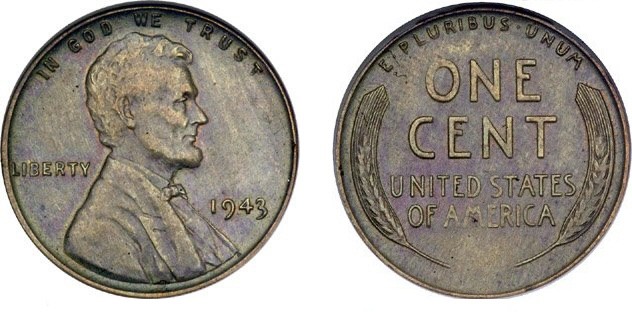
No mint mark — Struck with copper instead of steel; around 20 examples estimated
Mintage: 20. This coin is valued individually — no price guide covers a coin this rare.
PCGS values it at $390,000 in MS60BN.
Mint mark S — Struck with copper instead of steel; around 20 examples estimated
Mintage: 20. This coin is valued individually — no price guide covers a coin this rare.
PCGS values it at $1,000,000 in MS63BN.
| Date | Auction house | Price realized |
|---|---|---|
| Nov 2020 | Heritage Auctions | $504,000 |
Mint mark D — Struck with copper instead of steel; 1 example known
Mintage: 1. This coin is valued individually — no price guide covers a coin this rare.
PCGS values it at $1,700,000 in MS64BN.
| Date | Auction house | Price realized |
|---|---|---|
| Feb 2003 | Goldberg Auctioneers | $212,750 |
| Jan 2021 | Heritage Auctions | $840,000 |
Mint mark D — Boldly repunched mintmark
Mintage: unknown.
| Grade | Value | Graded | Finer |
|---|---|---|---|
| MS60 | $400 | 0 | 264 |
| MS63 | $450 | 40 | 210 |
| MS64 | $475 | 89 | 121 |
| MS65 | $950 | 70 | 51 |
| MS66 | $2,000 | 34 | 17 |
| MS67 | $8,750 | 10 | 3 |
| Date | Auction house | Price realized |
|---|---|---|
| Jun 2023 | Stack's Bowers | $660 |
| Apr 2023 | Heritage Auctions | $690 |
| Apr 2023 | Heritage Auctions | $1,260 |
| Dec 2009 | Heritage Auctions | $2,530 |
| Nov 2005 | Heritage Auctions | $489 |
| Jul 2010 | Heritage Auctions | $978 |
| Jan 2011 | Heritage Auctions | $920 |
Auction records
Real sales, not estimates. An auction result is one coin on one day, so individual prices land on both sides of the guide values above; the figures exclude the buyer's premium.| Date | Coin | Auction house | Price |
|---|---|---|---|
| Jan 2021 | D, Struck with copper instead of steel; 1 example known | Heritage Auctions | $840,000 |
| Nov 2020 | S, Struck with copper instead of steel; around 20 examples estimated | Heritage Auctions | $504,000 |
| Feb 2003 | D, Struck with copper instead of steel; 1 example known | Goldberg Auctioneers | $212,750 |
| Dec 2009 | D, Boldly repunched mintmark | Heritage Auctions | $2,530 |
| Apr 2023 | D, Boldly repunched mintmark | Heritage Auctions | $1,260 |
| Jul 2010 | D, Boldly repunched mintmark | Heritage Auctions | $978 |
| Jan 2011 | D, Boldly repunched mintmark | Heritage Auctions | $920 |
| Apr 2023 | D, Boldly repunched mintmark | Heritage Auctions | $690 |
| Jun 2023 | D, Boldly repunched mintmark | Stack's Bowers | $660 |
| Nov 2005 | D, Boldly repunched mintmark | Heritage Auctions | $489 |
| Jun 2024 | D | Stack's Bowers | $384 |
| Apr 2025 | S | Stack's Bowers | $85 |
| Aug 2025 | No mint mark | Stack's Bowers | $65 |
| Jun 2024 | No mint mark | Stack's Bowers | $45 |
How 1943 compares with the years around it
The question people ask straight after this one is how 1943 differs from the years on either side, and the answer is unusually clean: 1943 is the only year of the three that is steel. The cents of 1942 and 1944 are bronze, brown, non-magnetic and entirely ordinary, which is exactly why the errors run in both directions.
Bronze blanks left from 1942 produced the famous 1943 bronze cents. The mistake also happened in reverse: leftover steel blanks were struck with 1944 dies, giving a silver-grey 1944 cent that is just as wrong and just as valuable. So the same two tests work on either date — if a 1943 cent is not magnetic, or a 1944 cent is, you have something worth authenticating.
A practical consequence: do not judge these coins by colour alone. A brown 1943 cent is far more likely to be a copper-plated steel cent than a genuine bronze one, and a grey 1944 cent is far more likely to be a 1943 with an altered date. In both directions the magnet decides in a second what the eye cannot.
What to do with your 1943 penny
Don't clean it
Leave the surface alone — see the warning above.
Check the varieties
Go back through the 4 varieties above before deciding what you have — the difference between the common coin and the valuable one is usually a single detail.
Is it worth grading?
Grading costs roughly $50–100 per coin. For this coin it can pay off in high grades — MS67 examples are valued at $200, and the top of the scale runs to $4,250. Grading is worth considering only if the coin has no wear and full original lustre.
Where to sell
Dealer: fastest, pays least. Auction: best for coins worth $100+. eBay: most buyers, most fees.
Specifications
1 Cent "Lincoln - Wheat Ears Reverse"
- Composition
- Bronze
- Weight
- 3.11 g
- Diameter
- 19 mm
- Thickness
- 1.4 mm
- Edge
- Plain
- Designer
- Victor David Brenner
- Mints
- United States Mint of Philadelphia, United States Mint of Denver, United States Mint of San Francisco
1 Cent "Lincoln - Wheat Ears Reverse - Steel"
- Composition
- Zinc plated steel
- Weight
- 2.7 g
- Diameter
- 19 mm
- Thickness
- 1.5 mm
- Edge
- Plain
- Designer
- Victor David Brenner
- Mints
- United States Mint of Philadelphia, United States Mint of Denver, United States Mint of San Francisco
FAQ
Is a 1943 steel penny rare?
No. Philadelphia struck 684,628,670 of them, Denver 217,660,000 and San Francisco 191,550,000 — more than a billion coins in one year. A circulated example is worth about $0.21 to $0.22, and even a clean uncirculated one is usually a few dollars. They are common because they are unusual-looking, so millions of people saved them.
How do I know if my 1943 penny is copper?
Use a magnet, then a scale. The ordinary steel cent is magnetic and weighs 2.7 g. The bronze error is not magnetic and weighs 3.11 g. If your coin sticks to a magnet it is the common one, whatever colour it looks — copper-plated steel cents are the most frequent fake, and plating does not change the magnetic core underneath.
What is the most expensive 1943 penny?
The 1943-D struck on a bronze blank, which is the only one known from the Denver mint. It sold for $840,000 at Heritage Auctions in January 2021. PCGS values it at $1,700,000 in MS64BN. The San Francisco bronze cent, of which around 20 are known, brought $504,000 at Heritage in November 2020.
Why is the 1943 penny silver-colored?
Because it is not made of copper. Wartime demand for copper pushed the Mint to strike the 1943 cent on steel blanks coated with zinc, which gives the coin its grey, almost silver appearance. The composition went back to bronze in 1944.
How much is a 1943 penny worth with no mint mark?
A Philadelphia 1943 cent — the one with no letter under the date — runs from about $0.22 in low grade to $2.77 uncirculated. The value only becomes interesting at the very top of the grading scale: in MS68 the PCGS guide is $4,250, and only 91 examples have been graded that high.
Should I get my 1943 penny graded?
For an ordinary steel cent, almost never — grading costs more than the coin is worth in most grades. It is worth considering only if the coin looks flawless and fully lustrous, because MS67 examples are valued at $200 and MS68 at $4,250. If the coin is non-magnetic and weighs 3.11 g, that is a different conversation: get it authenticated immediately.
More on pennies
1965 Penny1966 Penny1967 Penny1968 Penny1969 Penny1970 Penny